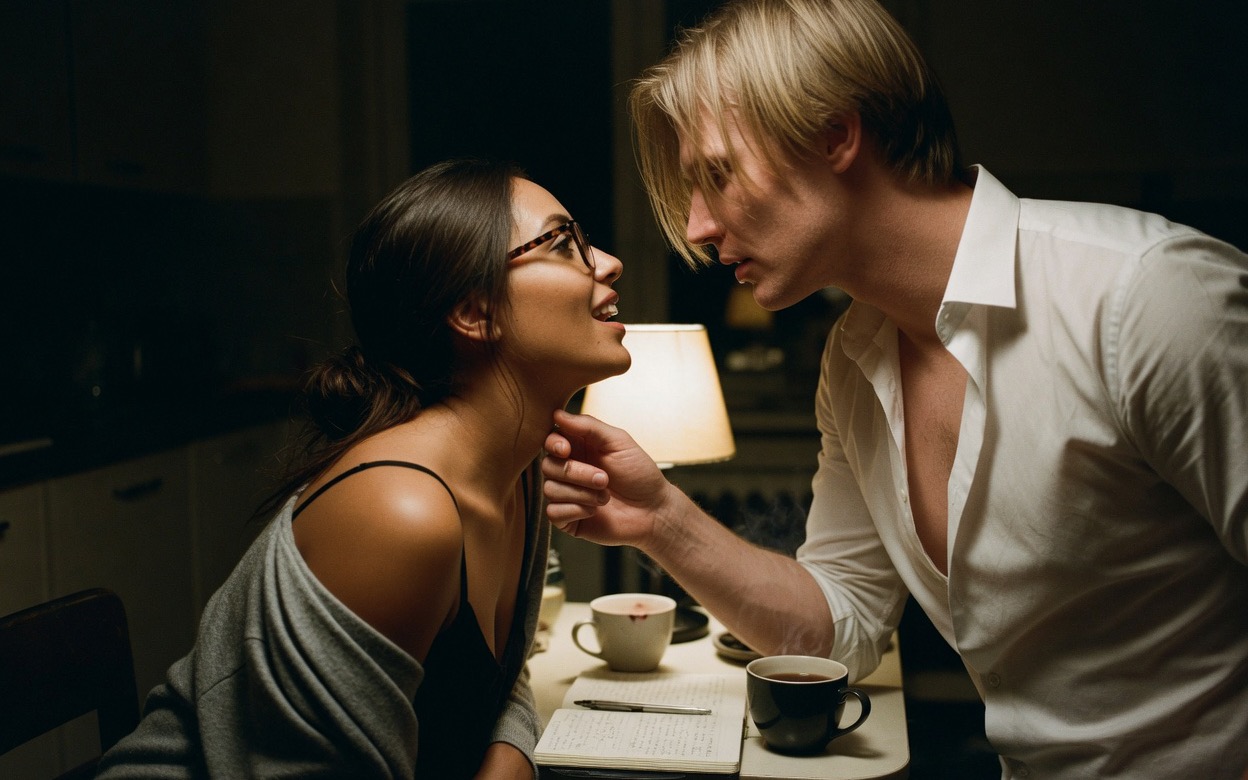
They had kept the arrangement since winter: his language for an hour, hers for the one after, in the café on the corner, until the café on the corner started closing at eight. Tonight the grate was already down when they got there, so she said her kitchen table would do, and he said nothing, which from him counted as agreement.
The notebook was the same one from the first Thursday, soft at the corners now. He had a verb wrong, or not wrong exactly — wrong in the mouth, right on the page. She made him say it a fourth time and a fifth, and on the fifth his face did the thing it did when he already knew before she told him.
"It's the vowel," she said. "You're making it with your teeth. It doesn't live there." "Then where," he said.
She didn't answer in words. She reached past the two cups and the open page, found his hand, and set his fingertips flat against the side of her throat, just under her jaw, where she could feel her own pulse arrive a half-second before her voice did.
"Here," she said, and made the sound again, slowly. "Feel where it starts."
He went very still, the way he did at the start of every new tense, and didn't take his hand back. The lamp between the cups was the only light left on in the apartment, and everything past the table had gone the soft black of a room nobody needed yet.
"Now you," she said, her voice lower for having just been under his hand, and he said the sound, and it came out of his teeth again, stubborn, and she laughed before she could stop herself, which was not unkind, only true. "Again," she said.
He leaned in without deciding to, the way a sentence sometimes finishes itself before you've chosen the ending, until his breath landed where his fingers already were. He tried the sound once more, slow, watching her mouth instead of the page, and this time her throat moved under his fingers as if to answer, though she hadn't said a thing.
What came out of him next wasn't the word from the lesson at all. It was a full sentence, rehearsed somewhere she hadn't been invited to watch, built badly in places and perfectly in one — the one he had clearly been saving since long before the café ever closed early.
She let the quiet hold it, his fingers still at her throat, her pulse doing the only talking either of them trusted right then. Then she answered him — correctly, in her own language, slow enough for every vowel to land where it belonged — and didn't translate a single word of it, and didn't have to.