He comes in March and again in October, always the last appointment of his day, and for four years she has made him tea and then left the room. The sound sets her teeth on edge, she tells him. It is the kind of thing that is true without being the reason.
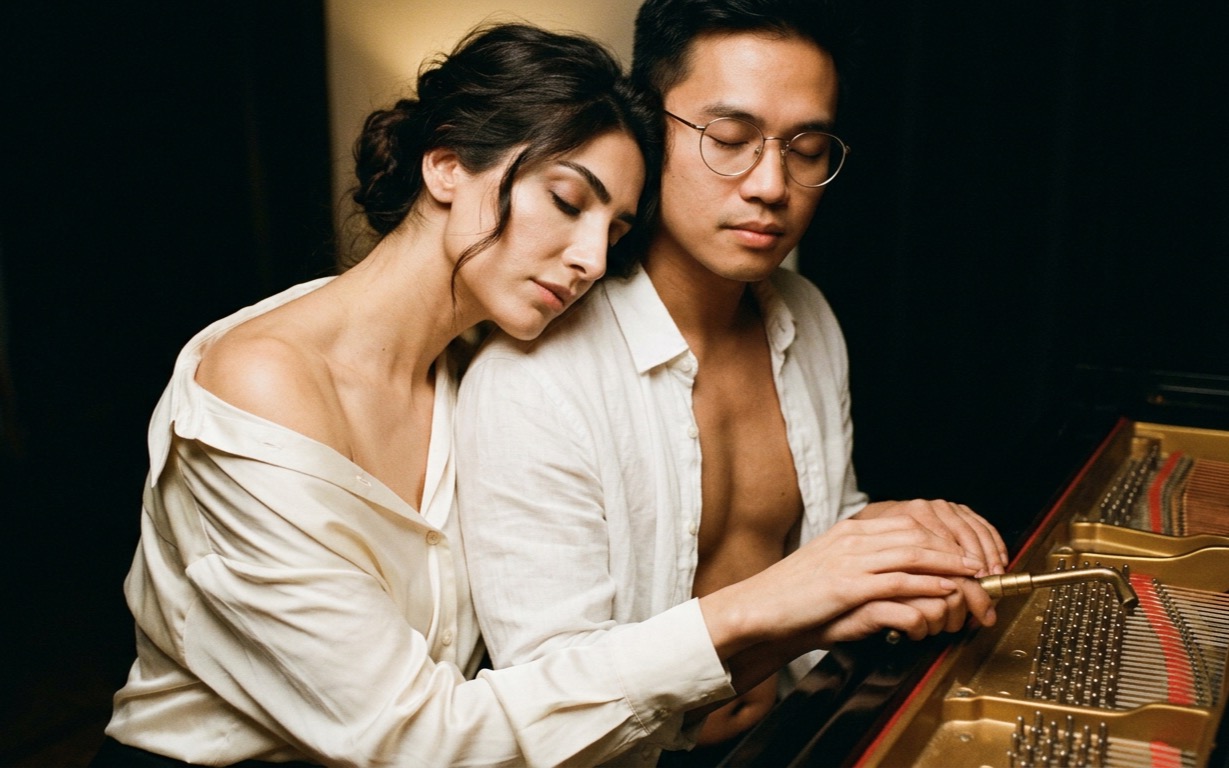
Tonight the tea goes cold on the windowsill. She sits at the far end of the bench while he props the lid open, and the inside of the piano comes into the lamplight: the copper-wound strings, the felt hammers in their row, the tuning pins set close as stitches.
He doesn't ask why she stayed. He presses a key in the middle and holds it down. Each note, he says, is two strings, sometimes three, and they're meant to agree. These two don't, not quite. Under the note she hears it — a slow waver, a pulse, something that can't make up its mind.
"That's the beat," he says. "The closer they get, the slower it goes. When it stops, they're the same note." He fits the lever onto the pin. "Tell me when it stops."
He turns it by less than she can see. The waver slows. She is aware of the bench taking both their weight, of his sleeve rolled to the elbow an inch from her bare arm, of four years of "see you in the spring" said at the front door with her hand already on the latch.
He strikes the key again. Slower now. Two strings leaning toward each other in the dark of the case. Nearly.
She puts her hand over his on the lever. Not to turn it — only to be there when it turns. His hand stops under hers. Then it goes on, slower than before, carrying hers with it.
The beat stretches until there is almost nothing between one pulse and the next. He is looking at her now, not at the strings. She knows she is supposed to say when. She doesn't say anything at all.
Much later the lid is still up and the lamp is still on, and one note in the middle of the keyboard has been left a hair sharp, unfinished.
"It'll keep till morning," he says into her hair, and she finds she no longer minds the sound.