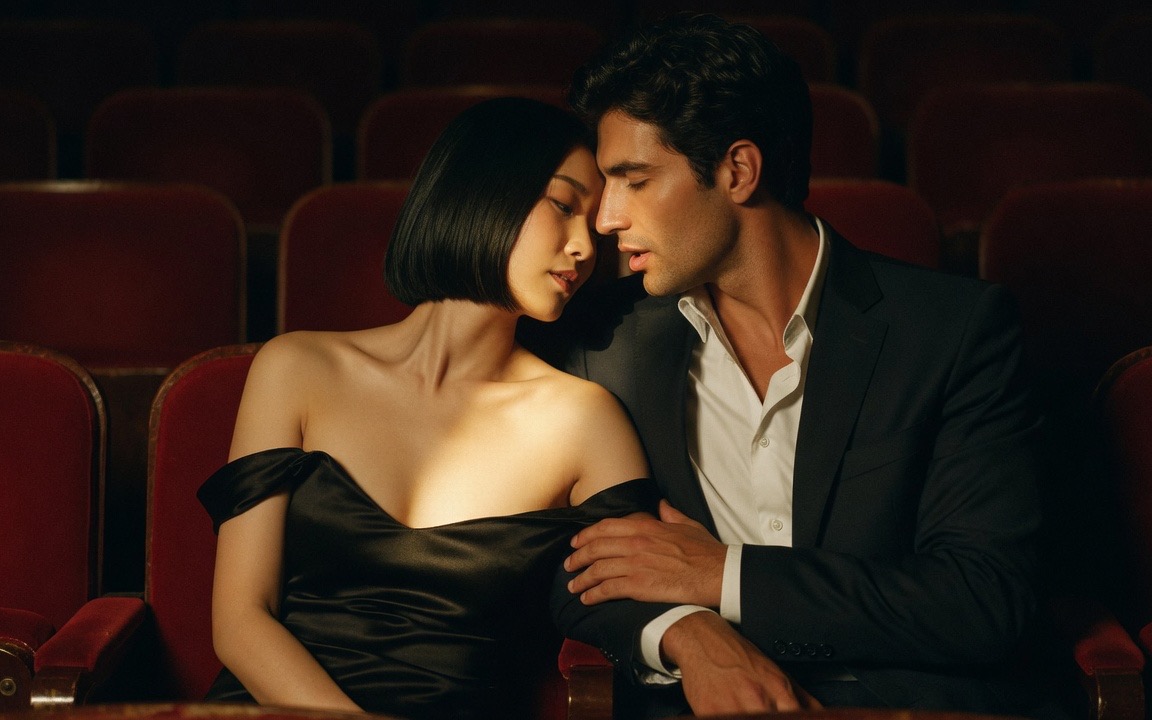
She'd bought the tickets in March, back when they were still an us — a birthday gift disguised as a Tuesday plan, two seats together in row H, in a hall where the silence between movements costs as much as the music does. Neither of them had thought to cancel. Some habits outlive the reason for them.
He was already in his seat when she found row H, jacket folded over one arm, program rolled the way he always rolled it, like something he might need to swat away with. She sat down beside him because the ticket said to, and for a second neither of them said anything at all.
"You came," he said, finally. Not a question.
"So did you," she said, and let that be the whole conversation.
The hall dimmed. The orchestra tuned itself down into silence, that held breath before a downbeat, and she became aware — the way you're aware of weather before it arrives — of the exact six inches between his sleeve and her bare arm along the shared armrest.
They'd played this once, badly, on the kitchen floor at midnight, his phone propped against a mug for a speaker, her sock feet keeping time while he conducted with a spatula he refused to put down. Now here it came again, in an actual hall, played by people who knew precisely what they were doing, and every slow bar of it seemed to know exactly where the two of them were sitting.
Neither of them moved the six inches. That was the whole of it for twenty minutes — the not moving, the sound climbing and holding and climbing again, his forearm warm along the wood, her pulse doing something she'd rather it hadn't in her throat.
When the house lights came up for intermission, they both flinched like people caught at something, though nothing, technically, had happened.
"Well," he said.
"Well," she agreed. Her arm still remembered the exact shape of his sleeve. "Second half's the good part," she said, because it was true, and because it postponed the truer thing.
He didn't get up to stretch his legs. Neither did she. The lights held them there a moment longer, two people who'd each kept their own ticket to the very same row, neither one reaching for the aisle, both of them, it turned out, staying for the whole program.