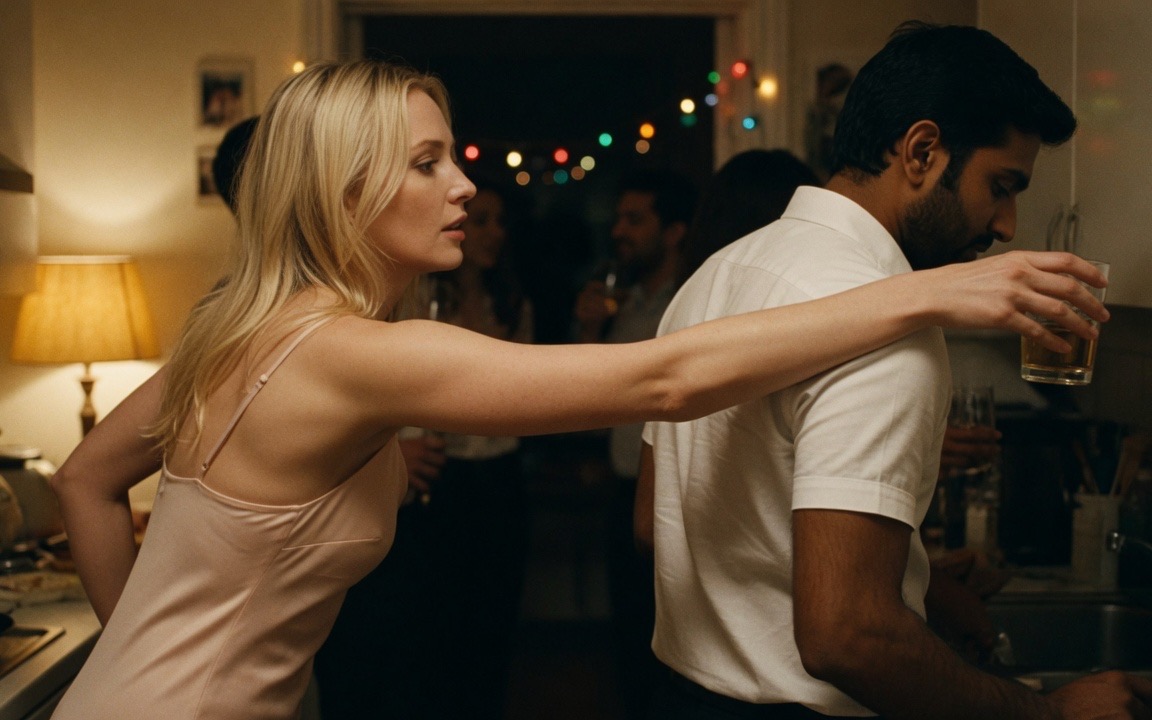
She didn't mean to end up alone with him. That was always how it started.
The kitchen was quieter than the rest of the apartment — just the refrigerator's hum and, now, him, turning when he heard her come in.
"Hey," he said. It was the same hey. The one that meant: I've been waiting.
She reached past him for a glass, the way she used to reach past him for everything — his whole body a familiar territory she'd lost the right to cross. Her arm grazed his shoulder. Neither of them moved.
They talked about the party. About mutual friends. About nothing at all. She watched his hands when he spoke — the way he pulled at his collar when he was about to say something true.
"You look—" he started. "Don't," she said. Not unkindly. He nodded, let it go. He had always known which sentence to leave unfinished.
She poured water she didn't want and stood there drinking it, and the whole terrible architecture of them rose up quietly around her — all the rooms they'd shared, all the silences they'd made specific.
Outside, someone laughed. Someone changed the song. He said her name, once, softly — not calling her anywhere, just saying it like something he still owned.
"I should go back in," she said. "Yeah," he said. He didn't move either.
And she thought: this is what no one tells you — that it doesn't fade. That the body keeps its own private record, patient as stone, ready to offer the whole history back at the slightest prompting.
She moved toward the door. Felt his gaze settle on her shoulder like a hand.
She didn't look back. That had always been her trick.