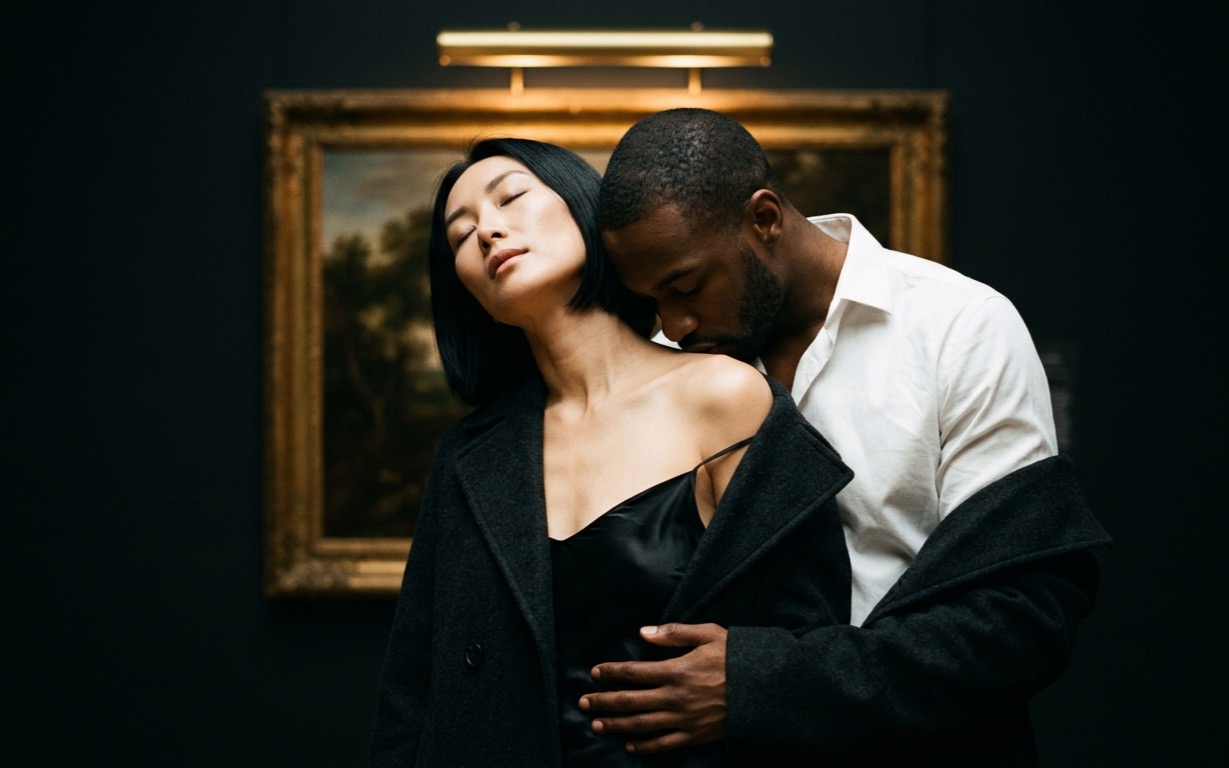
The museum kept late hours on Fridays in November, and by half past nine the guards had begun putting the galleries out the way you put out a house: one room at a time, from the far end, without hurry and without apology.
She had come alone, as she did every week, and so had he. They had noticed each other in the second room, again in the fourth, again beside a glass case of buttons nobody could explain. Neither had spoken. Each kept finding the other already there.
A switch clicked somewhere behind them. The room they had just left went dark, and its doorway became a rectangle of nothing. "That was the Dutch," he said, the first words either had given the other. "I wasn't finished with the Dutch."
"Neither was I," she said, already walking. "Come on."
So they went ahead of the dark, not fast, because you don't run in a museum, only forward, room to room, talking about everything on the walls and nothing off them: what a painter keeps back when he leaves the hands unfinished, why the sky is always done last.
He had come in out of the rain; it was still in the wool of his collar. She stood close enough to smell it, and he stood close enough that he'd stopped pretending the little label was what he was reading.
The last room was small and held one painting: a door left ajar in a house at night, lamplight laid across a floor in a long yellow slant. There was a bench. Neither of them sat. Down the corridor a guard's footsteps came unhurried, and stopped, and a key turned in a box.
"Last one," he said, almost kindly, and she felt him turn from the open door in the painting to her.
Then the light went, all at once and entirely, and there was only the sound of two people deciding to be quiet. His breath. Her sleeve against his sleeve. She turned her face the one inch it took.
Out on the front steps the cold arrived like a second opinion. She had lost a glove somewhere in the dark; her hand was in his coat pocket instead, laced with his, which was not a glove.
"I should tell you my name," he said. "Not yet." She tugged him down toward the one lit window on the street. "Ask me in the next room."